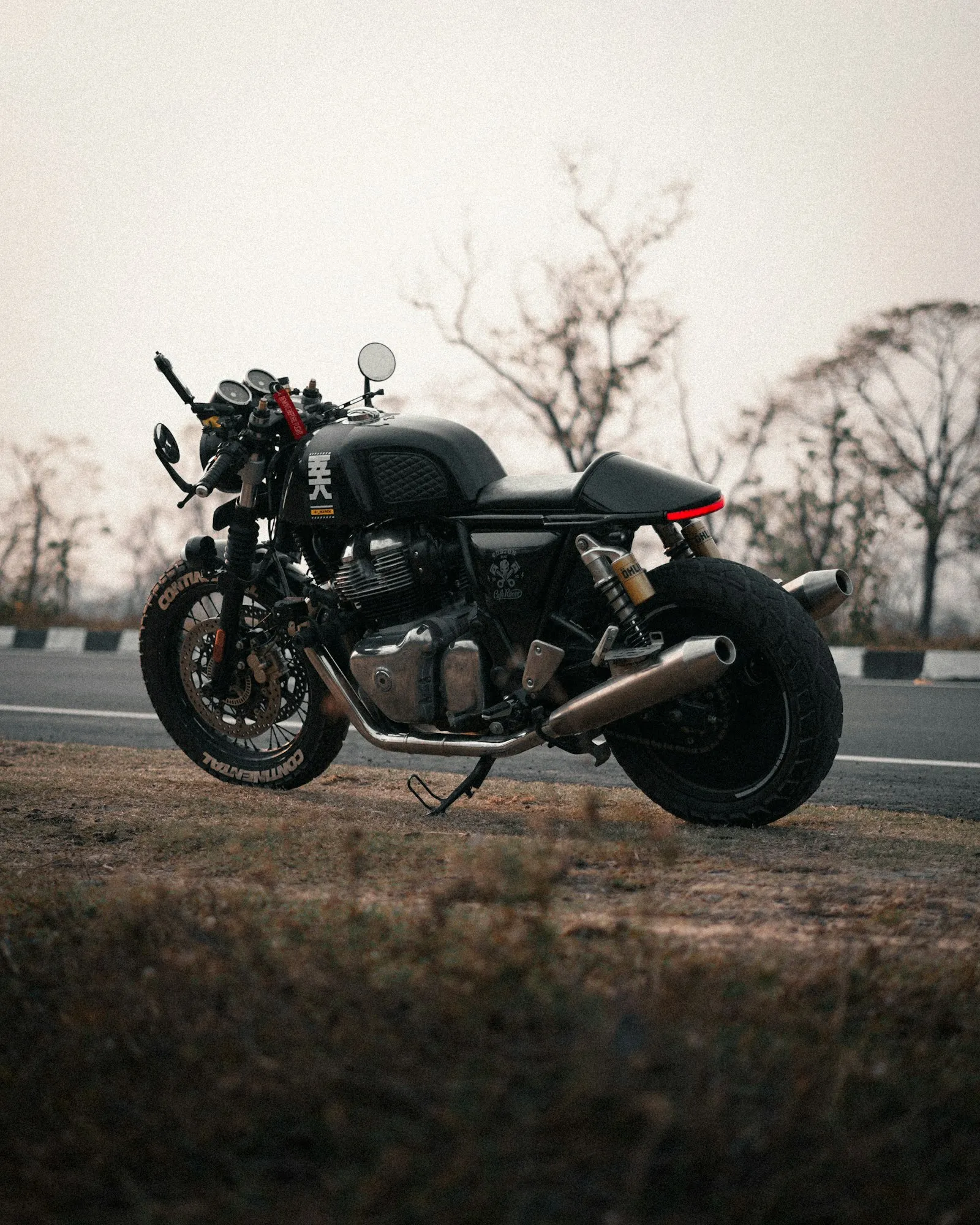
A flat track bike turns instantly because it has to. Short wheelbase, steep steering, weight forward, no front brake to upset it. Translating that to a road bike is almost entirely a geometry exercise, and geometry is where most tracker builds quietly fail.
The two numbers
Rake is the angle of the steering head from vertical. Trail is how far behind the steering axis the front tyre's contact patch sits. Rake is what you can change. Trail is what actually determines how the bike feels.
Less rake and less trail gives quicker steering and less stability. More of both gives a bike that runs straight and resists turning. A cruiser might run 32 degrees. A sportbike sits around 24. A street tracker wants 25 to 27.
How to change it without cutting anything
Ride height. Raising the rear of the bike rotates the whole chassis forward around the front axle, which steepens the rake and reduces trail. Roughly, 25mm of extra rear ride height steepens rake by about one degree.
You can do the same at the front by sliding the fork tubes up through the yokes, which lowers the front and has the same rotational effect. Twenty millimetres through the yokes is usually available without the front wheel touching anything.
Raising the rear 25mm steepens rake by about a degree. Doing it without checking the front is how trackers end up unstable.
The mistake everyone makes
Fitting longer rear shocks because the tail looks better level, and never touching the front. That steepens the rake and cuts the trail, and on a frame that was never designed for it the result is a bike that feels nervous and will not hold a line through a bend.
If you raise the rear, either raise the front by the same amount or accept that you have changed the handling and go and measure it.
Measuring rake at home
A digital angle gauge and a level surface. Put the gauge on the fork leg, not the frame, with the bike upright and both tyres at correct pressure. It reads within half a degree of the real number, which is plenty.
Do it before you change anything so you have a baseline. Without a baseline you are guessing about your own bike.
Donors worth hunting
See the table. All three are commonly available in Poland under 4,000 zloty, all three have frame geometry close to useful before you touch anything, and all three have parts support that will not leave you waiting six weeks for a gasket.
Numbers that matter
| Rake target | Street tracker on a standard frame | 25-27 deg |
|---|---|---|
| Trail target | Follows from rake and yoke offset | 85-100 mm |
| Rear ride height | Each 25mm steepens rake about 1 degree | +25 mm = -1 deg |
| Fork through yokes | Usually available without fouling | up to 20 mm |
| Donor: Yamaha XS650 | Straight frame, huge parts support | ~3,500 zl |
| Donor: Honda CB500T | Light, steep enough as standard | ~3,000 zl |
| Donor: Suzuki GS500 | Cheapest of the three, plentiful | ~2,200 zl |
Common questions
What rake angle should a street tracker have?
Between 25 and 27 degrees for a road-going tracker on a standard frame. Steeper than that gets nervous on real roads, and slacker than 28 starts to resist turning in the way a tracker should not.
How does raising the rear of a motorcycle change the handling?
It rotates the chassis forward around the front axle, steepening the rake and reducing trail. Roughly 25mm of extra rear ride height steepens rake by about one degree, making the steering quicker and the bike less stable.
How do you measure rake at home?
A digital angle gauge placed on the fork leg, with the bike upright on a level surface and both tyres at correct pressure. It reads within about half a degree, which is accurate enough. Measure before you change anything.
What is the best cheap donor for a tracker build?
The Yamaha XS650 if you can find one, for its straight frame and parts support. The Honda CB500T and Suzuki GS500 are cheaper and both have usable standard geometry.
Where can I see more of this build?
The full photo set for every build is on Instagram at @ironandgasolineofficial, and questions get answered there.
Got a question about this build, or built one yourself? The conversation happens on Instagram — the full photo set for this bike is up there, and I answer everything in the comments.
Join the thread on Instagram